


In-House Janitorial Staff vs. Outsourced Cleaning: Total Cost & Risk Analysis

September 6, 2026

Share this article

Evaluating in-house vs outsourced janitorial services forces operations leaders to look beyond the hourly wage of a cleaner. CFOs and facility directors frequently underestimate the administrative burden, liability, and capital expenditure required to maintain a functional internal cleaning department. Shifting from an in-house model to a managed outsourced contract replaces unpredictable variable expenses with a fixed, predictable monthly invoice. This analysis provides the framework to accurately measure your total physical and financial exposure before making a long-term procurement decision.

How Do You Evaluate In-House vs Outsourced Janitorial Services?

Evaluating in-house vs outsourced janitorial services requires comparing your total internal operational expenses against a fixed vendor contract. You must calculate direct wages, payroll taxes, benefits packages, workers' compensation premiums, equipment depreciation, and ongoing chemical supply procurement. Outsourcing shifts these financial liabilities and daily administrative burdens to a dedicated facility management partner.

When a commercial property directly employs a custodial team, the organization assumes every risk associated with that labor. If a cleaner calls out sick, the facility manager must either find internal coverage or allow the building to remain dirty. If a floor scrubber breaks down, the company must authorize an unbudgeted capital repair.

By contrast, professional commercial cleaning services operate on guaranteed performance standards. The vendor is contractually obligated to provide the staff, the equipment, and the management oversight necessary to keep the facility compliant and operational.

Direct Cost Comparison Worksheet

To make an objective financial decision, operations leaders must calculate the true labor burden of their internal staff. Use the following worksheet framework to compare your current in-house expenditures against a proposed outsourced vendor contract.

Cost Category In-House Financial Responsibility Outsourced Vendor Responsibility
Direct Wages Hourly pay rate for all custodial staff and necessary shift supervisors. Included in the fixed monthly contract price.
Labor Burden & Taxes Employer contributions for FICA, FUTA, SUTA, and payroll administration. Handled entirely by the vendor.
Employee Benefits Healthcare premiums, 401k matching, paid time off, and sick leave. Handled entirely by the vendor.
Workers' Compensation High premiums due to the physical risks and injury rates of janitorial labor. Vendor carries their own liability and workers' compensation policies.
Equipment Depreciation Purchasing, maintaining, and replacing vacuums, auto-scrubbers, and extractors. Vendor supplies and maintains all required commercial cleaning equipment.
Chemicals & Supplies Sourcing, inventorying, and purchasing floor finish, neutralizers, and disinfectants. Vendor provides proprietary dilution systems and commercial-grade chemistry.
PTO & Call-Out Coverage Paying overtime to remaining staff or suffering a drop in building cleanliness. Vendor guarantees shift coverage and manages all substitute labor logistics.

The Hidden Financial Risks of In-House Cleaning Departments

When an executive team looks at an outsourced cleaning proposal, they often compare the monthly contract total directly to the hourly wages of their current internal staff. This is a flawed financial calculation. The hourly wage represents only a fraction of the actual cost required to keep a building clean.

The True Labor Burden

Every internal employee carries a labor burden that significantly inflates their base pay. Beyond standard payroll taxes, commercial facilities must factor in the cost of benefits. Offering competitive health insurance, retirement matching, and paid time off is necessary to retain reliable staff. When you add these expenses to the base wage, the actual cost of an in-house cleaner is often thirty to forty percent higher than their hourly rate suggests.

Workers' Compensation and Liability

Janitorial work is highly physical. Cleaners spend their shifts lifting heavy trash receptacles, operating heavy floor machinery, and navigating wet surfaces. This makes the custodial department one of the highest-risk categories for workplace injuries. A single slip and fall incident or a repetitive motion injury can trigger a workers' compensation claim that raises your company premium for years.

When you outsource your cleaning operations, the vendor assumes this physical and financial risk. A reputable provider carries their own comprehensive workers' compensation coverage, shielding your facility from the liability of daily maintenance hazards.

Capital Expenditures and Equipment Depreciation

Cleaning a commercial building requires expensive, specialized machinery. A reliable HEPA-filtered backpack vacuum costs several hundred dollars. A battery-powered auto-scrubber required for large lobbies and warehouse corridors can cost several thousand dollars.

In-house departments must purchase this equipment outright, track its depreciation, and pay for ongoing repairs. When a machine breaks, the facility must wait for approval to buy a replacement. Outsourced providers supply their own commercial-grade equipment and maintain it independently. If a vendor floor buffer breaks down on a Tuesday, they bring a replacement unit on Wednesday, and your capital budget remains untouched.

Regional Challenges and Seasonal Equipment Needs

Operating a commercial building in Southern New England introduces unique seasonal challenges that strain in-house cleaning departments. The weather dictates the required scope of work, and those requirements change drastically throughout the year.

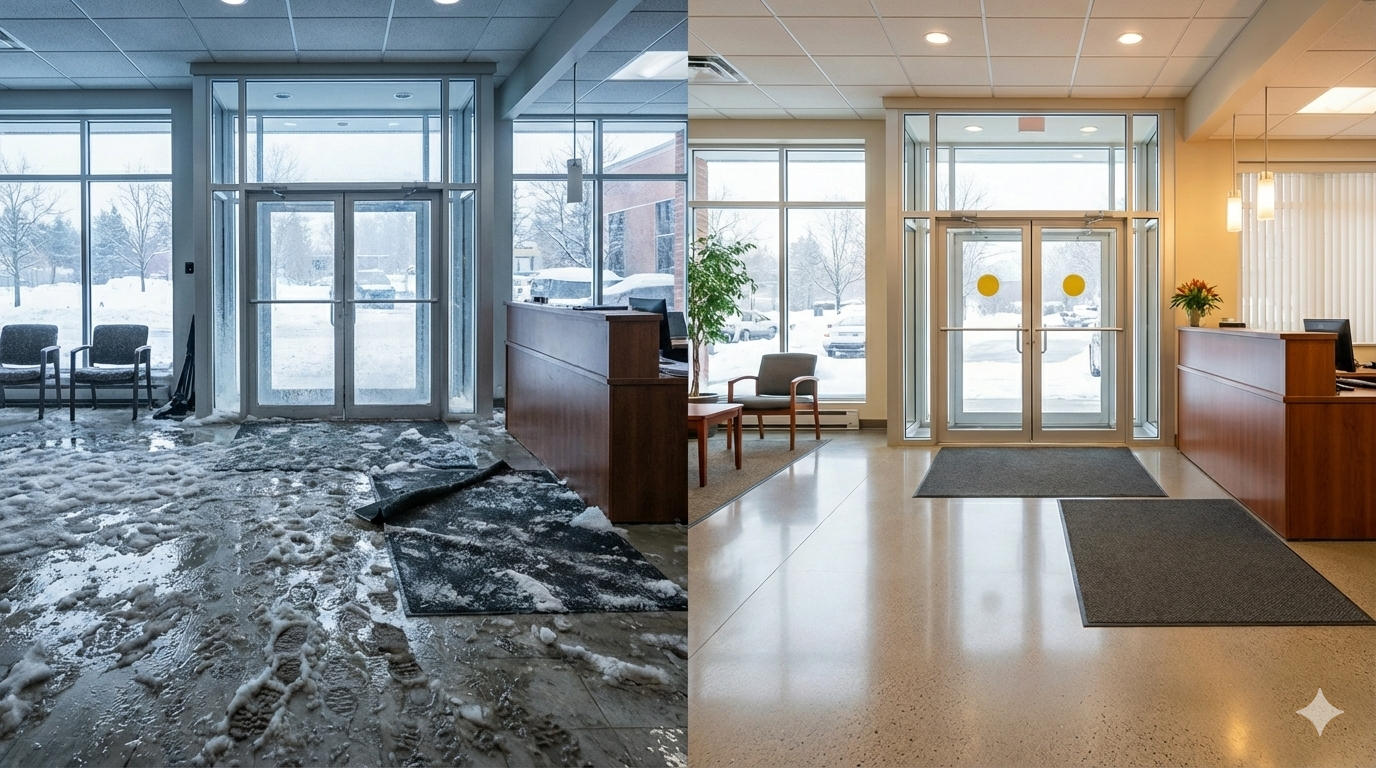
From December through March, facilities face a constant influx of abrasive sand, slush, and calcium chloride ice melt tracked across their entryways. Managing this winter soil requires heavy-duty walk-off matting, specialized floor neutralizers, and frequent carpet extraction. An in-house team must purchase and store this seasonal equipment for twelve months of the year, even though they only use it for four.

A professional Connecticut commercial cleaning company or Rhode Island vendor adjusts their equipment deployment based on the season. They bring heavy carpet extractors to your facility during the winter to remove salt barriers, and they rotate that machinery to other accounts during the summer. This shared resource model prevents your facility from sinking capital into equipment that sits idle in a maintenance closet for half the year.

The Operational Nightmare of Coverage Gaps

The most disruptive element of managing an in-house custodial team is handling attendance. Commercial buildings require consistent daily maintenance to remain safe and functional. Trash must be removed, restrooms must be sanitized, and floors must be swept every single night.

When an in-house cleaner calls out sick or takes a scheduled vacation, the facility manager faces an immediate operational crisis. They must either force other staff members to work overtime, pull employees from different departments to cover the deficit, or accept that the building will not be cleaned properly. This dynamic forces highly paid facility directors to spend their mornings acting as substitute janitorial dispatchers.

Outsourced service providers eliminate this administrative friction. A managed vendor operates with a deep bench of cross-trained personnel. If the primary cleaner assigned to your building is unavailable, the vendor account manager automatically dispatches a fully trained substitute. The facility manager never has to scramble for coverage, and the building occupants never notice a disruption in service quality.

The Importance of the Management Layer

The critical difference between a struggling internal department and a successful outsourced contract is the presence of a dedicated management layer. Many in-house cleaning teams fail because they lack structured supervision.

A facility director overseeing mechanical systems, HVAC contractors, and tenant build-outs does not have the time to inspect baseboards and monitor toilet paper inventory. Without consistent quality assurance, in-house cleaners naturally begin to cut corners. Service standards drift downward slowly until tenant complaints force the issue.

Professional commercial cleaning services for facility managers provide the accountability layer that in-house teams lack. You are not simply hiring people to push brooms. You are hiring an account manager who conducts documented monthly inspections, tracks defect rates, and corrects crew behavior before a problem escalates. This management structure reclaims hundreds of hours for your operations team, allowing them to focus on core asset management rather than janitorial quality control.

Frequently Asked Questions

  • How do you calculate the labor burden for an in-house cleaning team?

    You calculate the labor burden for an in-house cleaning team by adding all employer-paid taxes and benefits to the base hourly wage. This includes FICA, federal and state unemployment taxes, workers' compensation premiums, health insurance contributions, 401k matching, and paid time off.


    For most commercial facilities, this burden adds thirty to forty percent to the base payroll cost. If you pay an in-house cleaner eighteen dollars an hour, the actual cost to the company is likely closer to twenty-five dollars an hour once all administrative and benefit liabilities are calculated.

  • What equipment costs should be factored into an in-house janitorial budget?

    An in-house janitorial budget must include the purchase, maintenance, and eventual replacement of all required floor care and sanitation equipment. This covers commercial backpack vacuums, wet-dry vacuums, auto-scrubbers, floor buffers, carpet extractors, and microfiber flat-mop systems.


    Beyond machinery, the budget must account for proprietary chemical dilution stations, safety signage, and consumable tools. Facility managers must also calculate the cost of storing this equipment securely and the administrative time required to authorize repairs when machines inevitably break down.

  • How does outsourcing janitorial services affect facility liability?

    Outsourcing janitorial services significantly reduces a facility's liability by transferring the physical risks of cleaning to a third-party vendor. The cleaning contractor assumes responsibility for their employees' safety, training, and workers' compensation coverage.


    This protects your organization from claims related to repetitive motion injuries, chemical exposure, or slip and fall accidents that occur during routine cleaning duties. A professional vendor will provide a certificate of insurance proving they carry adequate general liability and workers' compensation policies before beginning any work on your property.

  • What happens when an outsourced commercial cleaner calls out sick?

    When an outsourced commercial cleaner calls out sick, the vendor's management team is responsible for dispatching a trained substitute to complete the shift. The vendor handles all logistical scheduling, communication, and overtime pay required to ensure the building is cleaned to contract standards.


    This is a major operational advantage over in-house teams. The facility manager does not need to source emergency coverage or deal with the administrative headache of sudden absenteeism. A reliable vendor delivers consistent daily results regardless of their internal personnel challenges.

  • How do you transition from an in-house cleaning team to an outsourced vendor?

    Transitioning from an in-house team to an outsourced vendor requires a structured thirty-day implementation plan. Begin by defining a precise scope of work that details exact cleaning frequencies, required standards, and building access protocols.


    The incoming vendor should conduct a detailed facility audit to establish baseline cleanliness levels. The facility manager must coordinate the removal of in-house equipment, facilitate the transfer of security credentials, and communicate the operational change to building tenants. A professional vendor will assign an implementation manager to oversee this process and ensure zero disruption to daily building operations.

Making the Final Procurement Decision

Choosing between an internal department and an external vendor is ultimately a decision about risk tolerance and operational focus. Building an accurate cost analysis reveals that managing a cleaning team internally drains capital, increases liability, and forces facility managers into the role of custodial supervisors. Outsourcing transfers that risk to a dedicated partner equipped to handle the staffing, equipment, and quality assurance required to maintain a commercial property.

Evaluate your current labor burden, review your equipment repair logs, and calculate the hours your operations team spends managing attendance issues. Once you quantify the true cost of an in-house model, the financial logic of a fixed, managed contract becomes clear.

If you want to review your facility's operational costs and current scope, System4 IPS schedules on-site facility walkthroughs across RI, CT, and Western MA, or you can reach the team at (401) 615-7043.

Recent Posts

Office hallway with two elevators and cleaning equipment cart beside them
September 3, 2026
Track vendor performance and eliminate cleaning defects with a janitorial quality control scorecard. Download actionable KPIs to audit your facility today.

Gloved hand wiping a metal door handle with blue cloth; text reads, “Your Facility Has Germ Hotspots. Do You Know Where?”
March 16, 2026
Discover 6 hidden germ hotspots in your facility and how often they should be cleaned to reduce absenteeism, complaints, and tenant churn.
Office split-screen: man reviewing papers beside “Commercial Cleaning Comparison” ad and a handshake with checklist.
January 5, 2026
Split-screen visual: Franchise chaos vs. System4IPS managed clarity. A single dedicated contact for New England commercial cleaning.
Snowy office lobby with glass doors, reception desks, and bright windows
December 17, 2025
Winter in New England is brutal on offices. From salt-eating floors to the flu season frenzy, her is the System4IPS guide to surviving the freeze without losing your mind.

Woman on phone holding a bucket to catch water leaking from the ceiling
November 17, 2025
When the Ceiling Leaks: How to Build a Facility Emergency Fund | System4 RI, CT & MA
Desk with calculator, pen, charts, and eyeglasses beside financial graphs and reports
November 13, 2025
Create facility management budgets without missing trends. Get expert advice from System 4IPS. Visit our site to learn more and plan effectively!
Five colleagues standing together in a modern office lobby, smiling with arms crossed
September 4, 2025
Don't take our word for it - read what RI, CT & MA businesses say about System4IPS commercial cleaning services. 99% client retention speaks volumes.
Person using an orange floor buffer on a glossy indoor floor
June 4, 2025
Don’t take our word for it—see the proof. System4 IPS delivers spotless commercial results in offices, restaurants, and apartments. Explore real transformations today!
Chef in white uniform holding his forehead in a busy commercial kitchen with stainless steel equipment
June 2, 2025
Need help passing a health inspection? System4 of Southern New England offers certified deep cleaning for restaurants, commercial kitchens, and food production facilities in RI, CT & Western MA. Emergency service available.
People sitting and chatting in a bright hallway with rugs, chairs, and potted plants
May 5, 2025
Ensure spotless student housing with expert turnover cleaning services. We deep clean apartments, dorms & shared housing to prepare units for fast, stress-free move-ins.
Show More