



One Cleaning Partner for Multiple Locations: Multi-Site Vendor Consolidation
Portfolio property managers overseeing a dozen buildings quickly realize that managing a dozen different cleaning companies is an operational nightmare. Every new property added to the portfolio multiplies the administrative burden of tracking invoices, verifying insurance, and standardizing quality. Implementing structured multi-location commercial cleaning management replaces vendor sprawl with a single point of accountability. Consolidating your facility services reclaims hundreds of hours for your operations team and guarantees that every building reflects the exact same standard of care.
The Administrative Burden of Decentralized Facility Maintenance
When property management firms allow individual building supervisors to hire their own janitorial crews, the portfolio fragments. You end up with five different companies servicing five different buildings. This decentralized approach means operations directors spend their mornings deciphering varied invoice formats, chasing down individual account managers, and trying to enforce a unified standard of cleanliness across completely different service models.
The hidden cost of this fragmentation is the administrative labor required to manage it. Your accounting department processes dozens of small invoices each month. Your risk management team must collect and verify separate workers' compensation policies and certificates of insurance for every vendor. If one cleaning company operates out of Rhode Island and another out of Massachusetts, keeping track of compliance documentation becomes a full-time job.
Beyond the paperwork, decentralized vendors create inconsistent tenant experiences. A corporate tenant visiting your Class A office tower in Hartford expects the exact same hygiene standards when they visit your satellite location in Warwick. When different vendors operate under different scopes of work, delivering that consistent experience is mathematically impossible.
What Is Multi-Location Commercial Cleaning Management?
Multi-location commercial cleaning management is an operational framework that consolidates all regional facility maintenance under one managed service provider. This structure provides portfolio property managers with a single dedicated account manager, one comprehensive monthly invoice, and uniform quality assurance inspections across every building in their inventory.
To visualize this model, consider a standard governance diagram for a consolidated portfolio. At the top sits the portfolio property manager. They communicate directly with one dedicated facility account manager. That account manager sits in the middle as the managed layer. They are responsible for dispatching, inspecting, and managing the individual cleaning crews assigned to each specific building.
This structure fundamentally shifts the operational burden. When a tenant complains about a dirty restroom in a suburban office park, the property manager does not have to track down the night supervisor for that specific building. They simply notify their dedicated account manager, who handles the remediation, diagnoses the root cause, and reports back when the issue is resolved. You direct the standard, and the management layer executes the details.
Centralized Billing Breakdown for Portfolio Managers
Moving from decentralized vendors to a consolidated partner transforms your accounting process. Instead of processing thirty different invoices from small regional cleaning crews, your finance department receives one centralized monthly statement. This single invoice details the exact spend for the entire portfolio while maintaining the necessary line-item granularity required for accurate property budgeting.
A proper centralized billing breakdown separates base recurring services from periodic project work. The invoice lists each property address individually. Under each address, it outlines the fixed monthly cost for nightly janitorial work. It then clearly itemizes any authorized periodic work completed that month, such as quarterly carpet extraction or emergency water damage response.
This transparency allows portfolio managers to run accurate cost comparisons across their buildings. You can instantly see if your medical facility in Springfield is consuming a disproportionate amount of consumable supplies compared to a similar building in Providence. Centralized billing turns scattered financial data into actionable operational intelligence. Utilizing professional commercial cleaning services that offer this level of administrative support is essential for scaling property management firms.
Regional Audit Standards Across RI, CT, and MA
Evaluating cleaning quality objectively across state lines requires a standardized inspection framework. A consolidated cleaning partner implements uniform regional audit standards across your entire portfolio. This means the lobby in a historic mill conversion in Rhode Island is judged against the exact same grading rubric as a modern corporate campus in Connecticut.
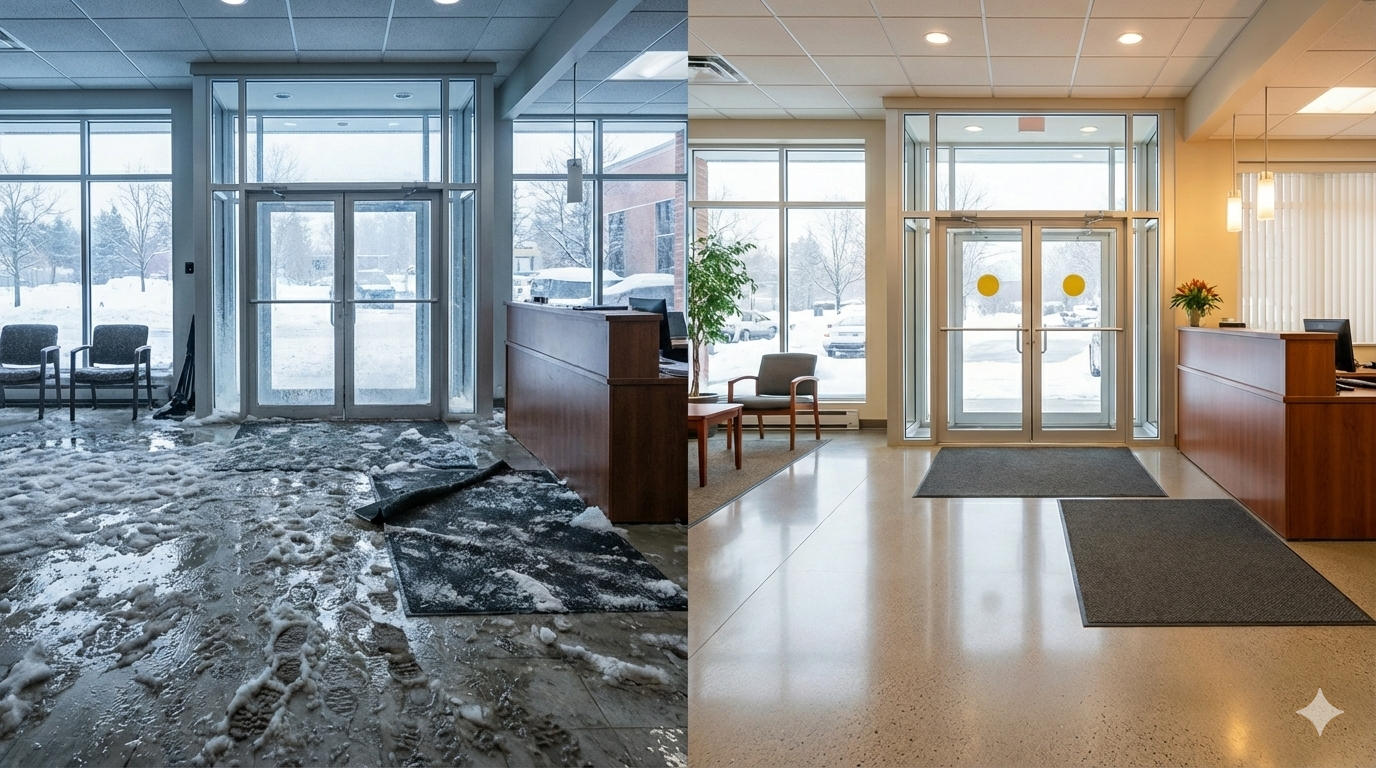
However, standardized scoring must account for specific regional variables that affect building maintenance. A reliable provider adjusts their execution to match the local environment while keeping the audit criteria consistent. Facilities along the Rhode Island coast face high humidity and salt air, requiring strict moisture control in restrooms and frequent interior glass maintenance. Properties located in Greater Hartford deal with heavy winter snow, requiring intensive entry matting programs to capture abrasive salt and sand before it destroys interior floor finish.
A dedicated account manager conducts regular joint walkthroughs with the property manager across all these locations. They use a standardized digital scorecard to record defect rates, track service level agreement compliance, and monitor periodic floor care schedules. If you manage a portfolio requiring a reliable Rhode Island commercial cleaning company, this structured auditing process ensures you have empirical data to verify contract performance month after month.
The Path to Facility Vendor Consolidation
Consolidating your vendor list is a strategic project that requires careful planning. You cannot simply fire a dozen cleaning companies on a Friday and expect a single new provider to seamlessly take over on a Monday. A professional transition requires a structured implementation phase to establish baseline cleanliness levels and align expectations across every site.
The process begins with a comprehensive portfolio audit. The incoming managed service provider walks every building in your inventory. They document the current condition of the floors, evaluate the existing consumable dispenser systems, and identify any specialized compliance requirements for medical or industrial tenants. This audit allows the provider to build a customized scope of work for each specific address while keeping the overall management structure unified under one master agreement.
Consolidation is the ultimate leverage point for portfolio managers. It reduces your administrative overhead, standardizes your building hygiene, and gives you the volume purchasing power to negotiate better rates on consumable supplies like paper towels and hand soap across your entire regional footprint. When you oversee multiple properties across the areas served in Southern New England, moving to a single managed partner is the most effective way to scale your operations without scaling your stress.
Frequently Asked Questions
How does multi-location commercial cleaning management improve quality?
Multi-location commercial cleaning management improves quality by applying a single, standardized inspection rubric across every building in a portfolio. A dedicated account manager conducts regular audits and corrects crew deficiencies before they become tenant complaints, ensuring consistent hygiene regardless of the property location.
When you use multiple small vendors, you rely on several different supervisors who all have different definitions of clean. A consolidated management layer eliminates this subjectivity. The provider establishes a strict scope of work and holds every crew accountable to that exact standard.
This approach also provides portfolio managers with aggregate data. You can track defect rates and response times across all your buildings in one dashboard, making it easy to identify which properties are performing perfectly and which require additional supervisory attention.
Can one vendor effectively clean different types of commercial buildings?
Yes, a managed facility services provider can effectively clean different building types by deploying specialized crews coordinated by a single account management layer. The account manager matches specific facility requirements with crews trained for those environments, such as assigning compliance-certified teams to medical offices and industrial crews to warehouses.
The strength of a managed network model is its deep bench of specialized personnel. A single small cleaning company might excel at standard office space but fail miserably when asked to maintain a sterile outpatient clinic. A managed provider pulls from a vetted network of specialists, ensuring the right personnel are always assigned to the right building.
This means a portfolio manager can confidently award a contract covering a corporate high-rise, a suburban manufacturing plant, and a retail strip center to one provider. The management remains centralized, but the execution remains highly specialized.
How are billing and invoicing handled for multiple properties?
Billing for multiple properties is handled through a single, consolidated monthly invoice that itemizes costs by individual building address. This centralized breakdown separates routine monthly janitorial fees from authorized periodic project work, allowing property managers to review the total portfolio spend at a glance.
Instead of your accounting department cutting checks to fifteen different vendors on varying payment schedules, they process one predictable payment. The invoice clearly delineates the expenses for each location, which simplifies the process of assigning costs to different property budgets or common area maintenance fees.
A professional provider will also include detailed backup documentation for any periodic work completed. If a crew performs an emergency water extraction at a specific tenant suite, the consolidated invoice will include the date, the location, and the authorized work order number alongside the charge.
What happens if a cleaner misses a shift at one of our locations?
If a cleaner misses a shift at one of your locations, the dedicated account manager automatically dispatches a fully cross-trained substitute to complete the required scope of work. The facility manager never has to scramble to find emergency coverage or deal with tenant complaints about unemptied trash.
Handling absenteeism is the greatest operational flaw of maintaining an in-house cleaning department or relying on a small local vendor. When their primary cleaner is sick, the building simply does not get cleaned. A consolidated managed provider guarantees coverage as part of the service agreement.
The account management layer monitors crew check-ins across the entire portfolio. If a gap occurs, they resolve it internally before the property manager is even aware there was a scheduling conflict. This structural redundancy is critical for maintaining safe, compliant commercial spaces.
How long does it take to consolidate facility services to a single provider?
Consolidating facility services to a single provider typically takes thirty to sixty days, depending on the size and complexity of the property portfolio. This transition period allows the incoming provider to conduct detailed site audits, build customized scopes of work, and establish standardized security access protocols.
A rushed transition leads to missed details and frustrated tenants. A structured onboarding process involves the dedicated account manager walking every building with the property manager to document expectations and identify historical problem areas left behind by the previous vendors.
During this implementation phase, the provider also installs new consumable dispensing systems, standardizes cleaning chemistry across all locations, and sets the schedule for joint monthly quality control inspections. Investing time in a proper transition guarantees smooth operations for the life of the contract.
Shifting to Consolidated Facility Operations
Transitioning to multi-location commercial cleaning management is a structural upgrade for any property management firm. Replacing decentralized chaos with a single point of accountability eliminates administrative friction, standardizes hygiene across state lines, and provides clear visibility into your portfolio spend. By partnering with a managed provider that delivers uniform regional audit standards and centralized billing, operations directors can stop micromanaging night crews and return their focus to core asset management.
If you want a second set of eyes on your current portfolio scope, System4 IPS schedules on-site facility walkthroughs across RI, CT, and Western MA, or you can reach the team at (401) 615-7043.